How to Read a Viator Listing Like a Pro (Using a Paris Perfume Workshop as the Example)
How to read a Viator listing: what the rating, review count, badge, inclusions and cancellation lines tell you, using a real Paris perfume workshop.
 By Antoine Lefèvre, Paris perfume workshop facilitator

People send me tour listings the way they send doctors their symptoms. Since I started running perfume workshops in Paris in 2022, friends of friends, past participants, complete strangers from group chats: they all forward a link with the same three words, "is this good?" So I have read a lot of Viator pages on other people's behalf, and I have a method. Here it is, walked through on a real example, the create-your-own perfume workshop near Trocadéro that this site covers in depth. By the end you will read any listing the way I do: fast, and in the right order.
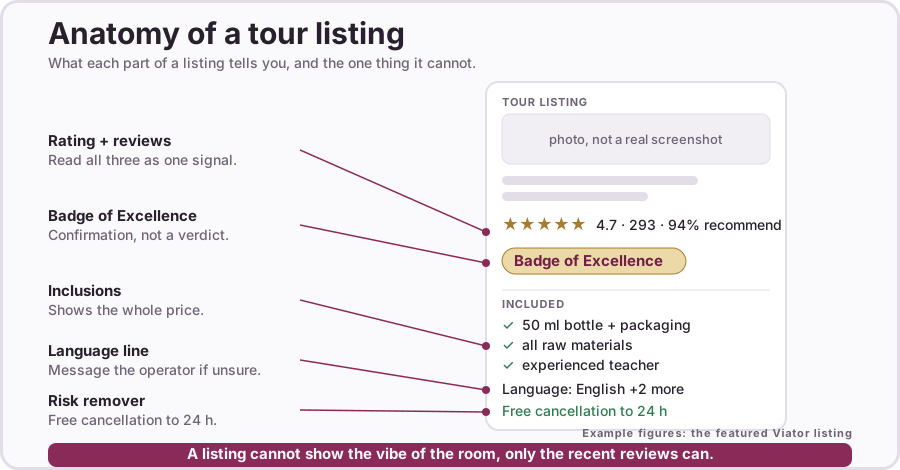
What do the rating, the review count and the percent line tell you together?
Read all three as one signal, never the stars alone. The example listing shows 4.7 out of 5 across 293 reviews, with a line saying 94% of travelers recommend the experience. The rating tells you how good, the count tells you how much evidence sits behind it, and the percent line tells you how the crowd splits.

A perfect 5.0 across nine reviews is a coin toss; a 4.7 across 293 is a pattern. That is the first thing the count does for you: it turns a score into a sample. Nearly three hundred people booked, showed up, and bothered to write, across seasons and group mixes and off days, and the average still held at 4.7. Almost no experience survives that many encounters without a few grumpy data points, which is exactly why a high score on a large count means more than a flawless score on a tiny one.
The percent-recommend line answers a different question: not "how did people score it" but "would they send you." At 94%, roughly nineteen of every twenty travelers said yes. When the rating and the recommend line agree, as they do here, you can trust the picture. When they diverge on some other listing, a decent average but a soft recommend rate, that is your cue to go read what the middle reviews actually complain about.
What is the Badge of Excellence, and how much should it weigh?
It is Viator's badge for consistently well-reviewed experiences, awarded on the strength of review performance. Treat it as a useful filter, not a verdict: it confirms the numbers you just read rather than replacing them.

The example workshop carries one. What I take from a badge like this is consistency over time, since a platform does not decorate a listing for one good month. What I do not take from it is anything precise, because the exact criteria are Viator's own and they do not publish a formula for the rest of us to audit. So my rule is simple: a badge plus strong numbers is confirmation, a badge on top of thin or mediocre numbers is marketing, and the numbers always outrank the ornament. Here, badge and numbers point the same way.
What do the inclusions and the fine print actually say?
The inclusions list is the honesty section of a listing. On the example page it reads: all raw materials, a 50 ml bottle with its packaging, and an experienced teacher. Elsewhere in the fine print sit the meeting point, 7 Rue Vineuse in the 16th, the language line, and a quiet detail worth more than it looks: you can reorder your scent later if you keep the formula.

Read inclusions for what is absent as much as what is present. "All raw materials" plus the bottle plus the teacher means the price you see at checkout is the whole price, with no surprise supplement for the thing you came to do. On listings where the take-home item is vague or missing from the list, assume it costs extra and check before booking.
The logistics lines deserve thirty seconds each. A street address as the meeting point, rather than "details after booking," tells you the operator runs a fixed venue, and this one asks you to be at the door about 10 minutes early. The language line here reads "English and 2 more" without naming the two; if your group needs a specific language, message the operator through the listing before you book instead of hoping. And the reorder line is the sleeper of the whole page. Most workshop bottles are the end of the story. A formula you keep makes the bottle the beginning of one, and I tell people to hunt for that detail on any perfume workshop listing, anywhere. You can see how each of these lines looks in place on the live listing.
Which lines remove your booking risk?
Two of them. "Free cancellation, full refund up to 24 hours in advance" means a Paris itinerary change costs you nothing until the day before. And the listing carries Viator's Reserve Now, Pay Later option, which lets you hold a date without paying upfront; the checkout for your date confirms the exact terms.

I care about these lines because travel plans are weather systems. Rain moves your museum day, a cousin appears in town, the jet lag wins. A 24-hour free-cancellation window converts a booking from a commitment into a placeholder, which changes how early you can afford to book: grab the morning slot you actually want the week before, knowing you can release it. The pay-later option does the same for your budget's timing. Neither line makes an experience better, but both make booking it a smaller decision, and on a listing this is exactly where I look before I let anyone pay.
What does a listing not tell you?
Two things, and they are the two people care about most: the vibe of the room and the style of the person teaching. No structured field carries either. The only place they live is in the recent reviews, so read the newest handful before you book, on this listing or any other.

A listing is a spec sheet. It will tell you the group is capped at 8 and the session runs about 1 hour 30, and on the example page it even names the instructor, the perfumer Marina Jung. What it cannot tell you is whether the room runs playful or reverent, whether the teaching is hands-off or precise, whether questions are welcomed or scheduled. Reviews leak all of this. Skip the five-star raves with no detail, find the recent reviews that describe a moment, and you will know more about the experience in five minutes than the structured data can say. I run workshops myself, so I say this with some self-interest in honest reading: the facilitator IS the product, and reviews are the only place a listing shows you one.
That is the whole method. Numbers first and together, badge as confirmation, inclusions for the full price, logistics for the practical traps, risk lines for peace of mind, recent reviews for the human part. Applied to the example, the signals stack up well, which is why it is the session this site features; the full breakdown of how it compares to the brand-house ateliers is in the honest comparison of Paris perfume workshops, the spec-sheet view lives on the workshop page, and the page with the live price and dates is the operator's Viator listing itself.