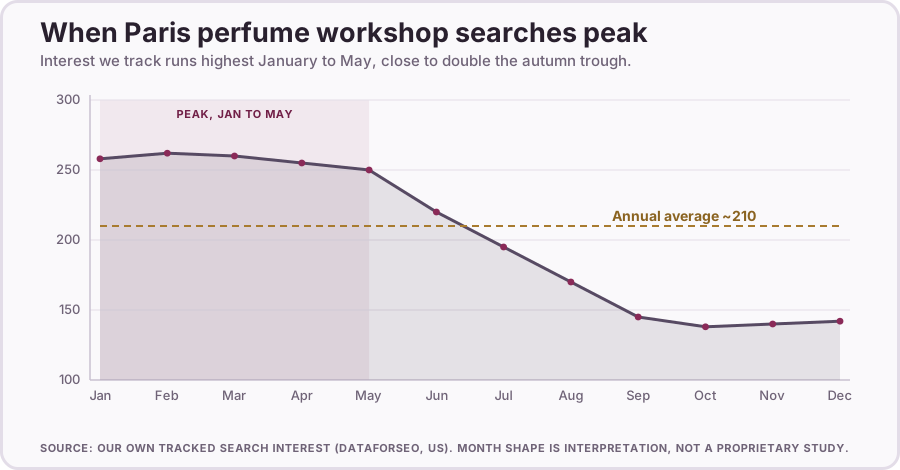
The demand curve we track, an 8-seat cap, and a free-cancellation clause: the three facts that settle the timing question.
Written with Antoine Lefèvre, Paris perfume workshop facilitator
Short answer
Book as soon as your Paris dates are fixed. The search interest data we track peaks from January through May and bottoms out September to December, the featured small-group session caps every departure at 8 travelers, and the listing gives free cancellation up to 24 hours before, with a reserve now, pay later option surfaced too. An early booking is free insurance: you lock a seat in the busy season and lose nothing if plans move.
Timing questions reach me in two flavors. One traveler is planning April and wants to know how early is early enough; another lands Thursday and wants to know if Saturday is hopeless. I have led perfume workshops in Paris since 2022, over a thousand participants by my own count, and the honest answer to both leans on three verifiable facts rather than folklore: a demand curve, a seat cap, and a cancellation clause. Here they are in order.
When should you book a perfume workshop in Paris?
As soon as your travel dates are fixed. The search interest data we track peaks from January through May, the featured session near Trocadéro takes 8 travelers at most, and the operator's listing gives free cancellation up to 24 hours before the session. Booking early costs nothing and holding off can cost you the date.
That is the whole argument compressed. When demand for a thing rises for five months of the year, the thing sells in units of 8, and stepping back out is free until the day before, the math has one answer. The rest of this page unpacks each fact so you can check my reasoning against the sources, and the comparison page covers how the alternatives handle booking if you are still choosing an operator.
When is demand for Paris perfume workshops highest?
From January through May, per the search interest data we track: the head search cluster averages about 210 US searches a month across the year, runs around 260 through the January to May peak, and eases to roughly 140 from September to December. Peak months carry close to double the trough's interest.
Read month by month, the recorded series says this much and no more: the first five months of the year sit at the top of the curve, the last four sit at the bottom, and the summer in between falls somewhere in the middle by simple arithmetic, since the annual average of about 210 has to live between a 260 peak and a 140 trough. I will not pretend to per-month precision the data does not have.
My read of why, offered as interpretation rather than fact: January through May is planning season. People book spring city breaks in winter, and a perfume workshop is a plan-ahead activity rather than an impulse one. Whatever the cause, the practical consequence is plain. If your trip lands between January and May you are traveling when the most people are hunting the same few benches, so book earliest then. A September to December trip gives you more slack, though slack is not a guarantee, which brings us to the cap.
Interest we track for Paris perfume workshops sits highest from January through May, close to double the September to December low.
Season
Months
Relative interest
Peak
January to May
About 260, the annual high
Summer
June to August
Mid-range, between the two bounds
Autumn low
September to December
About 140, the annual low
The annual average across the head cluster sits near 210, so the summer figure is arithmetic rather than a recorded point.
Why does an 8-seat cap change the booking math?
Because a sold-out session is just 8 people. The featured workshop's listing caps every departure at 8 travelers, so a single family plus one couple can close a time slot, where a museum-scale operation absorbs demand by the busload.
Scale is the difference worth staring at. Fragonard's free museum carries 7,200 reviews on its Google listing, which tells you what kind of daily foot traffic a big house handles; venues built for that volume rarely sell out of anything. An 8-seat atelier session is the opposite animal. The cap is exactly why the best workshop guide rates the small-group format highest, the perfumer actually works with you at that size, but the same cap means the good dates go first, and in the January to May window they go fastest. Small groups and easy last-minute availability are, structurally, opposites. Pick which one you want to bet on.
What makes early booking zero-risk?
The cancellation clause. The operator's Viator listing gives a full refund up to 24 hours before the session, and it surfaces a reserve now, pay later option as well. A booking made months out is a free hold on a seat, not a locked-in spend.
This clause is what turns "book early" from salesmanship into arithmetic. The downside of booking in January for an April session is zero: itinerary shifts, you cancel by the day before and pay nothing. The downside of waiting is a closed date on an 8-seat product in peak season. One side of that ledger is empty. I tell my own participants the same thing about any small-cap activity with free cancellation, not just perfume: reserve first, optimize later. The live price for your date sits on the listing, and the cost guide covers what the fee includes once you are there; the session itself, all materials, a 50 ml bottle you compose, and a formula you keep for reorders, is detailed on the featured workshop page.
What is the best day of the week or time of day?
I do not know, and neither does anyone selling you certainty about it. We track no data on weekday versus weekend demand or morning versus afternoon sessions, so this section will not invent a pattern.
The seasonality series above is real, recorded and on file. A best-Tuesday-at-ten claim would be none of those things, and this site does not print numbers it cannot source. What I can offer instead is procedure: open the listing, look at which time slots exist for your actual dates, and treat whatever is still bookable as your answer for that week. If a slot you wanted is gone, that is the 8-seat cap doing what caps do, and the neighboring day usually solves it. One practical note from the bench side, offered as preference rather than data: your nose is part of the equipment, so pick a slot where you will not arrive straight from a heavy meal or a long day, whichever hour that means for you.
Viator Badge of Excellence
Best for first-timers, couples and anyone who loves scent
Paris Create your Own Perfume Workshop with a Perfumer
4.7across 293 Viator reviews, 94% recommend
Blend and bottle your own 50 ml perfume with a perfumer's guidance, near Trocadéro
Small group of 8 at most, about 1 hour 30 minutes, offered in English
All raw materials included, and you can reorder your scent later if you keep the formula
Live price on the listing shown for your date and currency at booking
Free cancellation up to 24 hours before. Ratings are the operator's current Viator figures; check the listing for today's price.
How does each month of the year rank for booking pressure?
Group the year by the three points the data actually records. January through May sits in the peak band, near 260 tracked searches a month. September through December sits in the low band, near 140. June through August lands in the middle by arithmetic, around the 210 annual average. Anything finer than those three bands is my read, not the record.
I keep a running sense of when benches fill, and it maps onto those bands rather than onto any single hot month. The table below spreads the year across all twelve months so you can find yours, but read the two right-hand columns as a facilitator's judgment, not tracked figures. Only the demand bands come from the data.
Month
Tracked demand band
Booking pressure, my read
How early I would lock a seat
January
Peak, near 260
Rising fast as spring trips get planned
8 to 12 weeks out
February
Peak
High, winter planning in full swing
8 to 12 weeks
March
Peak
High, spring breaks land
10 to 12 weeks
April
Peak
Among the busiest felt, spring in Paris
10 to 12 weeks
May
Peak
Still high before the summer plateau
8 to 10 weeks
June
Mid
Moderate, summer visitors arrive
4 to 6 weeks
July
Mid
Moderate, steady tourist flow
4 to 6 weeks
August
Mid
Moderate, the city itself runs quieter
4 to 6 weeks
September
Low, near 140
Easing off the summer
3 to 4 weeks
October
Low
Slack returns
2 to 4 weeks
November
Low
Among the quietest felt
2 to 3 weeks
December
Low
Low in our data despite the holidays
2 to 3 weeks
Only the three demand bands, peak, mid and low, are recorded. The pressure notes and lead times are my planning allowances, the same ones I would give a friend, not figures anyone tracks.
How big is the swing between busy and quiet months?
Put plainly, the top of the year runs close to double the bottom. The peak band near 260 tracked searches sits about a quarter above the 210 annual average, and the low band near 140 sits roughly a third below it. Peak against trough works out to about 1.9 to 1. Those three levels are the only ones the data fixes; every point between them is interpolation.
I find the swing easier to act on as ratios than as raw counts. A busy month is not marginally busier than a quiet one, it is nearly twice as busy, and that gap is the whole reason lead times stretch in spring. The arithmetic below runs only on the three recorded anchors, nothing invented.
Demand band
Tracked level
Against the 210 average
Against the 140 low
Peak, January to May
Near 260
About a quarter higher
About 1.9 times
Annual average
Near 210
Baseline
About 1.5 times
Low, September to December
Near 140
About a third lower
Baseline
Read it as a rule of behavior, not a forecast for any single week. When a product sells eight seats at a time, a demand band running near double the low is more than enough to close your first-choice date before you get to it. That, and nothing more dramatic, is why spring booking rewards moving early.
How far ahead do I actually tell people to book?
My rule of thumb, offered as judgment and not data: two to three months for a January to May trip, three to four weeks for the autumn low, and same-week booking treated as a gamble in any month. Nobody publishes a lead-time statistic for these sessions, so I will not dress mine up as one. It is simply the allowance I would give my own family.
People want a number here, and I understand why, but the honest version is a range tied to the season you are traveling in. The 8-seat cap is what drives it. A session that sells in units of eight does not need a citywide surge to close a date, it needs one family and a couple who booked before you did. So the busier the demand band, the earlier I nudge people.
Trip season
Lead time I suggest
Tightest I would cut it
Why
January to May peak
8 to 12 weeks
About 3 weeks
Top demand band meets an 8-seat cap
June to August mid
4 to 6 weeks
About 2 weeks
Mid band, some slack but not much
September to December low
2 to 4 weeks
A few days
Low band leaves the most room
Notice what the free-cancellation clause does to this table: it removes the cost of erring early. If I tell you eight weeks and your plans firm up at ten, you have lost nothing by holding the seat. That asymmetry is why every number in the left column leans early rather than late.
What is Paris like in each season for a workshop trip?
A perfume workshop is an indoor, weatherproof plan, which is exactly why it earns a spot on a rainy-day itinerary. Spring and autumn give the kindest walking weather around the Trocadéro venue, summer runs warm and crowded, winter is cold with short days. The session itself is identical whatever the sky is doing.
This matters less for the workshop than for what you pair it with. The atelier sits in the 16th near Trocadéro, indoors, so the season never touches the ninety minutes you spend at the bench. One point worth settling early: you do not need to travel south to Grasse, the historic capital of French perfumery in Provence, to do any of this. The houses that started there run their ateliers in Paris, and the featured session is Paris through and through.
Season
Months
Paris in general
Why the workshop still fits
Spring
March to May
Mild, chestnuts in leaf, streets filling
Indoor hour pairs neatly with outdoor sightseeing
Summer
June to August
Warm, long days, peak visitors, quieter in August
A cool indoor hour out of the heat
Autumn
September to November
Cooler, thinner crowds
Booking slack, easy to slot beside a museum
Winter
December to February
Cold, short days, some rain
A weatherproof plan earns its keep
None of the weather here is a tracked figure, just the ordinary rhythm of a Paris year. What the data does say is that demand for the workshop and the tourist high season are not the same curve: the search interest we track actually dips in autumn, exactly when the walking weather turns pleasant and the crowds thin.
What exactly does free cancellation protect you from?
It covers the entire downside of booking early. The operator's Viator listing gives a full refund up to 24 hours before the session, so a seat held in January for an April date costs nothing if the trip moves. The one thing the clause will not rescue is a change of heart inside the final day, when you should expect to be charged.
I lean on this clause more than on any forecast, because it turns timing from a bet into simple bookkeeping. Line up the two ways to play it and the ledger is lopsided.
What happens
Booked early with free cancellation
Waited to book
Your dates shift
Cancel by 24 hours before, full refund
No loss, but no seat was ever held
Your date sells out
Seat already yours
Gone, on an 8-seat product
You change your mind inside 24 hours
Expect to be charged
Charged too, if you had booked
You forget to book at all
Cannot happen, it is done
The common way people miss out
Three of those four rows favor booking early, and the fourth is a tie. That is the whole case. The reserve now, pay later option the listing surfaces only widens the gap, since it softens even the upfront outlay. Treat the day before your session as the real decision deadline and everything ahead of it as reversible.
Which booking move fits your trip?
Match the move to the trip in front of you. Fixed peak-season dates: book now and cancel free if they change. Flexible autumn dates: you have room, but the 8-seat cap still rewards booking ahead of the week you want. Already in Paris and chasing a slot: check the listing's live availability and take the neighboring day if your first choice is gone.
Most timing questions I get are really one of a handful of situations wearing different clothes. Here is how I would play each.
Your situation
The move I would make
If it is full
Firm January to May dates
Book the moment the dates are set
Try an adjacent day in the same week
Flexible autumn trip
Book a few weeks out, no rush
Slack usually holds, shift by a day
Already in Paris, want this week
Check live availability right away
Neighboring day, or lean on low-season slack
A group of several
Book early, you fill the cap fast
Split across two sessions
Whatever your row, the mechanics underneath are the ones this page has already laid out: a demand curve that peaks January to May, a cap of eight, and a refund clause that runs to the day before. The move changes, the facts do not.
Common questions about when to book a perfume workshop in Paris
How far in advance should you book a perfume workshop in Paris?
There is no published lead-time statistic, so the honest rule is structural: sessions cap at 8 travelers and cancellation is free to 24 hours before, so book the moment your dates are fixed, especially for January through May, the peak of the search demand we track. Early booking has no downside to offset.
Can you book a Paris perfume workshop last minute?
Sometimes. Nothing in the data forbids it, but an 8-seat cap means a single group can close a slot, and peak-season dates go first. Check the live availability on the operator's Viator listing for your exact day; outside January to May your odds improve.
What is the cheapest time of year for a perfume workshop in Paris?
The brand houses publish flat prices on their own pages year round, and the featured session's price varies by date and currency on its listing rather than by a published seasonal calendar. What clearly moves with the season in our data is demand, not list prices, so timing buys you availability more than savings. The published numbers are all in the ratings and prices dataset.
What happens if my plans change after I book?
The featured workshop's listing gives a full refund on cancellations made up to 24 hours before the session, and it surfaces a reserve now, pay later option. Inside the final 24 hours you should expect to be charged, so treat the day before as your real decision deadline.
Is there a best day of the week for a perfume workshop?
No data we track answers that, and this site does not guess in numbers' clothing. Availability on the listing for your specific week is the only real signal; the 8-seat cap means it changes daily.
Lock a date, risk free
Free cancellation to 24 hours and live availability are on the operator's official Viator listing.